Introduction
What Ecofunding is, the problem it solves, and the role of blockchain as the operational infrastructure.
About this document
In this section
Definition
Ecofunding is a platform that allows private investors to access real environmental projects directly, using blockchain technology as an operational infrastructure to reduce complexity, opacity, and inefficiency in finding environmental projects.
Private investors participate economically in projects involving real environmental areas, carbon credit generation, and sustainable agricultural production. Through productive environmental land, Ecofunding combines the physical environment with a structured digital representation, maintaining a clear separation between the real environmental area, legal contracts, and the ecosystem tokens.
Problem
The market for supporting environmental projects presents significant barriers:
- Access restricted to large private investors
- Low operational transparency
- Complex, poorly standardized contracts
- Low liquidity
- Difficulty tracking the actual generation of environmental value
In addition, access requires high capital, concentrating it in a few agents and making it rare for small and medium private investors to participate in a proportional and auditable way in carbon credit or regenerative agriculture projects.
The absence of adequate technological infrastructure increases costs, dependence on intermediaries, and information asymmetry.

Restricted Access to Environmental Assets
Large environmental projects normally require high capital for land acquisition and operational structure. As a consequence, participation is limited to large companies, funds, or institutional investors.

Complex Validation Structure
Carbon credit generation involves rigorous technical processes, independent audits, and multiple layers of verification. In practice, only organizations with large structures can navigate this process efficiently.

Concentration of Value
As a result of entry barriers and operational complexity, most credits and economic benefits remain concentrated in a few players. This imbalance creates a market that is hardly accessible, even when the environmental asset is abundant.
Solution
Ecofunding addresses these barriers by economically fractioning environmental areas, making participation accessible at scale. The distribution of the economic results that this environmental area may generate is automated, and carbon credit generation becomes auditable by third parties. The model is based on three pillars:
- Real environmental area as the economic base — productive environmental areas, audited and with validated technical feasibility.
- Blockchain infrastructure — proportional record-keeping, automation of economic flows, and traceability.
- Contractual and compliance structure — mitigation of regulatory risks and legal alignment.
The investor participates economically in:
- Generation of carbon credits
- Sustainable agricultural production
- Future appreciation of the environmental asset
- Possible final sale of the area
Reducing intermediaries simplifies the structure and aligns incentives between private investors and environmental projects.

Democratic Access to Environmental Projects
Ecofunding enables investors to participate in real environmental projects without needing to acquire large land areas or operate complex structures. Through a proportional digital structure, access is no longer exclusive to large companies.

Structured and Transparent Validation
Environmental value generation follows technical processes and independent audits, ensuring credibility and integrity. Ecofunding organizes this structure in a clear and traceable way, allowing investors to track the origin and validation of the credits generated.
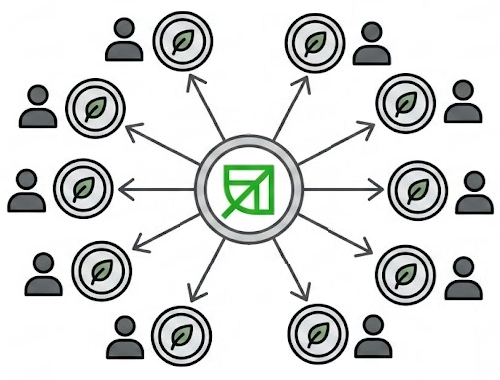
Proportional Distribution of Value
The economic results generated by the projects are distributed proportionally among ecosystem participants. Instead of remaining concentrated in a few intermediaries, environmental value can reach investors connected to the platform directly.
Role of the blockchain
Blockchain is used as the operational infrastructure.
Its role is to:
- Record proportional economic participation
- Automate distributions of economic results
- Enable public traceability
- Reduce reliance on trust in intermediaries
- Allow flexibility in asset management
The use of the technology is functional and instrumental, subordinated to the real asset and the legal structure.